Academic Integrity Standard
Standards for Ethical Expert Review and Authentic Student Research
OUR CORE PRINCIPLE
SRA exists to strengthen student thinking, not replace it. Every SRA service is designed to preserve student ownership of the research while providing rigorous, transparent, expert feedback.
1. Purpose
The SRA Academic Integrity Standard defines the boundaries that govern Science Research Academy Expert Review services. It is intended to protect the authenticity of student research, establish clear expectations for students, families, educators, and reviewers, and ensure that SRA feedback supports learning without becoming authorship, ghostwriting, data manipulation, or completion of a student's work.
SRA's standard is informed by widely accepted principles of scientific integrity and by current pre-college research competition expectations. Students remain responsible for the originality, accuracy, documentation, analysis, interpretation, and presentation of their own research.
2. The Student Owns the Research
The student researcher must remain the intellectual owner and primary author of the project. The research question, research plan, experimental or engineering work, data collection, analysis, conclusions, paper, poster, presentation, and responses to judges must reflect the student's own understanding and work, subject to appropriate guidance from teachers, mentors, and qualified supervisors.
THE SRA TEST
After an SRA review, the project should still sound like the student, reflect the student's decisions, and be defensible by the student without relying on an SRA reviewer.
3. What SRA Reviewers May Do
SRA reviewers may provide expert feedback that helps a student identify, understand, and address issues in their own work. Reviewers may:
Identify strengths, weaknesses, gaps, inconsistencies, or unclear reasoning.
Ask questions that prompt the student to think more deeply about the research.
Flag methodological, statistical, feasibility, safety, ethical, or competition-rule considerations.
Explain scientific or research-design concepts relevant to a concern identified in the submission.
Recommend areas that require clarification, additional reading, verification, or discussion with a teacher or mentor.
Comment on organization, clarity, visual communication, and whether claims appear supported by the information submitted.
Identify questions that a mentor, reviewer, or competition judge may reasonably ask.
Suggest categories of possible approaches or considerations without selecting or completing the student's solution.
Provide grammar, syntax, formatting, or presentation feedback when doing so does not replace the student's authorship.
4. What SRA Reviewers Will Not Do
SRA reviewers will not perform work that should be completed by the student. SRA will not:
Write or rewrite a student's research plan, abstract, paper, poster, presentation, or competition response for submission as the student's work.
Create a research question, hypothesis, methodology, engineering solution, or conclusion on the student's behalf.
Generate, fabricate, alter, selectively omit, or manipulate research data or images.
Perform an analysis for the student and provide results that the student presents as their own work.
Create or invent citations, references, sources, participant responses, experimental observations, or other evidence.
Complete required research forms, consent documents, risk assessments, or approval materials on the student's behalf.
Circumvent or substitute for required teacher, mentor, IRB, SRC, IACUC, institutional, school, or fair oversight.
Guarantee approval, eligibility, publication, advancement, awards, or competition outcomes.
Coach a student to conceal outside assistance, AI use, mentor involvement, or any other contribution that should be disclosed.
5. SRA's Standard for Artificial Intelligence
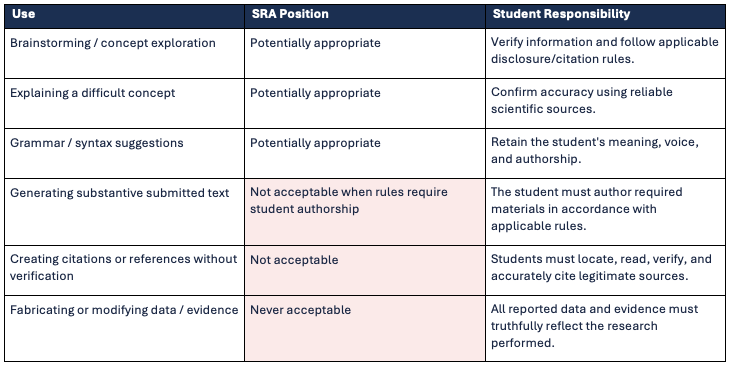
SRA recognizes that artificial intelligence can be a legitimate research and learning tool when used transparently and within the rules that apply to the student's school, research institution, publication, or competition. AI must not become a substitute for the student's independent scientific thinking or authorship.
Students participating in a specific competition must follow that competition's current AI policy, even when it is more restrictive than SRA's general guidance. For example, current Regeneron ISEF rules allow AI as a project resource with appropriate acknowledgment but prohibit generative AI from writing the research plan, abstract, or poster and from creating citations.
6. Scientific Integrity
SRA expects students and reviewers to uphold the following principles throughout the research process:
Honesty: Report methods, observations, results, limitations, and contributions truthfully.
Originality: Distinguish the student's work from the work of mentors, collaborators, laboratories, AI systems, and other researchers.
Transparency: Disclose assistance, tools, prior work, and contributions when required.
Accuracy: Verify claims, calculations, sources, citations, and representations of data.
Objectivity: Avoid intentionally selecting, excluding, or presenting evidence in a misleading way.
Respect: Protect human participants, animals, confidential information, intellectual property, and the work of other researchers.
7. Research Oversight and Approval
An SRA Expert Review is advisory. It is not an approval process and does not authorize a student to begin research. When a project requires review or approval by an Institutional Review Board (IRB), Scientific Review Committee (SRC), Institutional Animal Care and Use Committee (IACUC), Institutional Biosafety Committee, school, research institution, affiliated fair, or other authority, the student must obtain that approval through the appropriate process.
IMPORTANT
A favorable SRA review does not mean that a project is approved, safe to begin, eligible for a competition, or compliant with every applicable rule. Students must confirm requirements with the authorities responsible for their specific project.
8. Reviewer Independence and Conflicts of Interest
SRA reviewers are expected to provide candid, objective feedback. Reviewers should disclose actual or potential conflicts of interest and should not review a project when a relationship, financial interest, competitive interest, or other circumstance could reasonably compromise impartiality.
SRA may reassign a submission when the subject matter falls outside a reviewer's expertise or when another reviewer is better positioned to evaluate the work.
9. Confidentiality and Student Work
Student submissions should be treated as confidential review materials and used only as necessary to provide the requested SRA service, administer quality control, and satisfy applicable legal or operational requirements. Reviewers may not claim student ideas, data, writing, or intellectual property as their own or share student work outside the review process without authorization.
10. The Student's Responsibility After Review
SRA feedback is a set of expert observations and recommendations, not a set of instructions that must automatically be followed. The student should evaluate the feedback, discuss material changes with the appropriate teacher or mentor, make their own scientific decisions, and personally complete all revisions.
A SUCCESSFUL SRA REVIEW
The student finishes the process with a stronger understanding of the project, clearer scientific reasoning, and greater ability to explain and defend their own decisions - not simply a more polished submission.
11. Violations of the SRA Academic Integrity Standard
SRA may decline, pause, or terminate a review when submitted materials or requested assistance appear to involve fabrication, plagiarism, undisclosed authorship, inappropriate AI use, falsified citations, manipulated data, attempts to evade required oversight, or requests for SRA to complete work that must remain the student's own.
When appropriate, SRA may explain the concern and redirect the student toward an academically appropriate form of assistance. Payment, refund, and service terms are governed by the applicable SRA purchase terms.
12. Student & Family Commitment
By submitting work for SRA Expert Review, the student and purchaser affirm that:
☐ The submitted work accurately represents the student's research and current level of contribution.
☐ The student will not present SRA reviewer language as original student-authored work when doing so would violate applicable rules or policies.
☐ The student will independently evaluate and implement any revisions.
☐ The student will disclose assistance and AI use when required.
☐ The student will obtain all required approvals before beginning regulated research.
☐ The student understands that SRA feedback does not guarantee any academic, publication, or competition outcome.
13. Alignment With Competition and School Rules
This standard establishes SRA's minimum expectations. A student's school, district, research institution, journal, affiliated fair, or competition may impose additional or more restrictive requirements. The most restrictive applicable requirement should be followed. Because competition rules change, students are responsible for checking the current rules for each program in which they intend to participate.
Reference Framework
This standard is informed in part by the Society for Science Regeneron ISEF International Rules and Guidelines, including its Ethics Statement, roles and responsibilities for student researchers and adults, and current guidance on artificial intelligence. SRA is an independent organization and this document does not imply endorsement by or affiliation with Society for Science or Regeneron ISEF.
SCIENCE RESEARCH ACADEMY
Your Research. Your Work. Expert Guidance.